
Coaching, mentoring, consulting and therapy are four helping professions, and people confuse them all the time.
The difference rests on 2 questions. Who holds the answers? Who owns the result? Each profession answers them differently, and that changes the kind of support you get and the outcome you can expect.
In coaching, the coachee holds the answers and owns the result. In mentoring, the mentor shares answers from experience. In consulting, an expert supplies the solution. In therapy, a licensed clinician assesses and treats a mental health concern.
How do coaching, mentoring, consulting and therapy compare?
| Profession | Who holds the answers? | Who owns the result? |
|---|---|---|
| Coaching | The coachee | The coachee |
| Mentoring | The mentor, from experience | The mentor leads and guides |
| Consulting | The consultant | The consultant delivers the fix; the client owns the problem |
| Therapy | The therapist, a licensed clinician | The therapist assesses and treats; you own the issue |
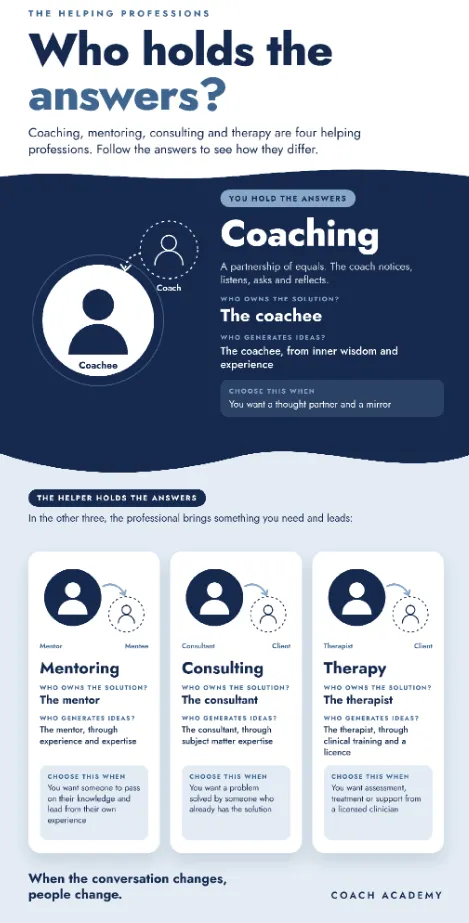
In our ICF coach certification programs, people quickly realize that what they thought was coaching is mentoring or consulting. The next thought usually sounds like this: “How will I ever stop giving people advice? What is my value if I can’t share my experience and wisdom?” The answer is simple, and unsatisfying for the ego: the coachee is the wisest person in the conversation.
When I believe you are whole, capable and resourceful, do I need to give you advice? You are the person who holds every detail of that board meeting, that difficult conversation or that project launch. The best thing I can do is partner with you: evoke awareness, reveal your bias and challenge your perspective until new choices surface. You hold the answers to your own problems.
What is coaching?
Coaching is a partnership of equals. This distinction is important. An equal partner does not judge, evaluate, assess or prescribe. In other helping professions, there is a hierarchy. The mentor holds the wisdom and experience, the consultant holds the preconceived solution, the therapist has the care required. Each has a cherished outcome that they own and lead.
A coach helps a person become more aware of their own experience, think for themselves and reach their own goals. The coach assumes the coachee is wise, capable and whole. The coach’s role is to evoke awareness, challenge fixed ideas and bring new information and options to the surface. Sir John Whitmore, author of Coaching for Performance, called building awareness and responsibility the essence of good coaching.
Coaching is for people who see something they want to change, have a vision of what they want and are willing to do the work. Those 3 conditions echo a well-known formula for change, published by Richard Beckhard and Reuben Harris and credited to David Gleicher: dissatisfaction, vision and first steps together have to outweigh resistance. When a person is ready to do that work, a coach is the right helping professional.
Mentors, consultants and therapists step in when readiness for change requires additional, externally resourced support. The helping professional has something the client needs. A coach can work in collaboration with other helping professionals, as long as the client is coachable.
A coach doesn’t have to be an expert in your field. A coach’s expertise is coaching: the skills, strategies and techniques that make space for others and help a person think, see themselves clearly and find out what they are capable of.
It’s why top athletes have coaches. The athlete has the talent. The coach is the outside eyes and ears, observing and reflecting back what the athlete can’t notice while performing. Most of us overrate how well we know ourselves. Organizational psychologist Tasha Eurich found that 95% of people believe they are self-aware, and she estimates that only 10% to 15% are.
Coaching skills are connection skills. They help us connect with other people, and they challenge us to unlearn the communication habits that keep us from being present and objective. Listening, self-management and observation are rarely taught in school, and they are seldom treated as competencies. We take them for granted, and yet they are the most important human skills, and they belong at the core of communication strategies.
What is mentoring?
Traditional mentoring is a relationship of reliance. A person with more experience shares their expertise with someone more junior or newer to a field. The mentor’s career and experience lead the conversation, and the mentee relies on that expertise to advance and learn new skills.
Great mentors take a coach approach to mentoring. They ask open-ended questions, then observe and reflect what they hear before offering options. They learn to manage their own bias, listen without competing, lead with curiosity and partner with the mentee.
What is the difference between coaching and mentoring?
The difference between coaching and mentoring lies in who owns the answers. A coach asks questions that bring a coachee’s knowledge and lived experience to the surface, so the coachee learns to trust themselves and builds self-reliance, agency and identity.
A mentor assumes others can learn from their experience, so the mentor owns the answers, passes on knowledge and guides.
Overdone, mentoring can leave a mentee short on initiative, resourcefulness and self-reliance, and that can become a cycle of disempowerment.
What is consulting, and how is it different from advice?
Consulting is expert opinion and expert solutions. A consultant studies your problem, advises you on how to fix it and often delivers the fix.
The client owns the problem and the consultant owns the answers, which may create dependency.
Everyday advice, the kind a friend or a boss offers, is the form of consulting we all know. Advice may fit when the problem is specific or technical. The trouble is that most advice arrives with an assumption about the problem already built in.
Three decades ago, researchers Avraham Kluger and Angelo DeNisi pooled 607 results from studies of feedback. Feedback made performance worse in more than a third of cases. That held for positive feedback as well as negative. Advice often arrives dressed as feedback, and the risk is advice that starts from the assumption that the other person doesn’t know. That can trigger defensiveness and shut a person down.
Not all conversations are coaching conversations. However, a coach approach can be powerful in the most unexpected ways. Your tax return doesn’t need a coaching conversation. Yet when an accountant adopts a coach approach, clients feel safe and partnered with, and the accountant can break through preconceived notions about the client and hear the opportunities in a unique situation. When subject matter experts lead with questions, more context appears, then more opportunities, which might just lead to lower taxable income!
What is therapy?
Therapy is mental health care from a licensed clinician. A therapist is trained to find and treat mental health problems, such as anxiety or depression. You own the issue, and the therapist has the training to treat it.
Therapists work under strict rules. They must meet set standards for education and hold a licence to practise.
What is the difference between coaching and therapy?
Coaching is not therapy. It is, however, therapeutic.
Therapists assess, diagnose and treat. They hold clinical degrees and licences, and their profession is regulated.
Coaches are trained to refer a coachee to a therapist when they see signs that clinical care is needed, or when the support required is beyond the coach’s knowledge or skill. The ICF Code of Ethics and ICF’s referral guidelines treat the line between coaching and therapy seriously.
Coaching is still a self-regulated profession. ICF coaches are trained, mentored and credentialed, and they pledge to follow the ICF Code of Ethics. Anyone can file a complaint against an ICF member or credential-holder, and ICF investigates through its Ethical Conduct Review process. You can check a coach’s credential on the ICF website.
Early research suggests the coaching relationship can be as strong as the therapy relationship. In a 2022 study of one digital mental health service, people rated their working relationship with coaches and with therapists equally high, 4.8 out of 5, and a stronger relationship predicted bigger gains in well-being in both groups.
What kind of help do I need?
Start with what you want to leave with.
- You want to explore your own experience, lead the conversation with what matters to you, and have a witness who observes, challenges and evokes new awareness: hire a coach.
- You want to learn new skills or acquire knowledge from an expert in a field: find a mentor.
- You want to lean on someone else’s expertise to solve your problem: call a consultant, or ask for advice.
- You feel stuck or low, you can’t name what you need or feel, and it’s affecting your daily life: reach out to a licensed therapist or your doctor.
We often confuse what each helping profession is for. We give advice at work and at home because having the answer is how we learned to show we are smart and useful.
Coaching puts the coach in a position of humility, which can feel vulnerable and uncomfortable at first. The person across from you, meanwhile, feels supported, seen, heard and valued.
Graduates of the Academy often say the same thing: the first life to change was theirs.
Try this experiment
The next time someone brings you a problem, hold your advice for 5 minutes. Ask a WHAT question (“What do you already know about this?”) and then stop talking. See what happens in the silence.
Stay present while they answer. Notice their body language, practise your listening, then ask another WHAT question. Watch the person across from you get clearer and more confident as you listen.
Don’t take my word for it. Use your next conversation as a laboratory.
On the other side of coaching, is connection.
Nathalie
Frequently asked questions
Is coaching the same as therapy?
No. Therapy is mental health care from a licensed clinician who assesses and treats. Coaching is a partnership of equals that helps a person who is ready for change reach their own goals.
Can a coach give advice?
A coach’s job is to ask questions that help you find your own answers. Advice belongs to mentoring and consulting. A coach who also mentors or consults should tell you when they switch roles.
Do coaches need a licence?
Coaching is a skill. It does not require a licence, so anyone can call themselves a coach. Credentials from professional bodies such as the International Coaching Federation are voluntary and recommended.
What is a coachee?
A coachee is the person being coached. Some coaches say “client.” Both words mean the same person.
What is the difference between coaching and consulting?
A consultant studies your problem and delivers the solution. A coach asks questions so you find your own solution and own the result.
References
- International Coaching Federation. What is coaching? Definition of coaching.
- International Coaching Federation. Referring a client to therapy.
- Coaching definition and distinctions. Handout shared by Tim Kincaid, EdD, PCC, attributing the therapy, consulting and mentoring distinctions to ICF.
- Grant, A. M. (2001). Towards a psychology of coaching: The impact of coaching on metacognition, mental health and goal attainment. Doctoral thesis, Macquarie University.
- Theeboom, T., Beersma, B., and van Vianen, A. E. M. (2014). Does coaching work? A meta-analysis on the effects of coaching on individual level outcomes in an organizational context. The Journal of Positive Psychology, 9(1), 1-18.
- European Mentoring and Coaching Council. Mentoring Centre for Excellence (current definition of mentoring).
- Aboujaoude, E. (2020). Where life coaching ends and therapy begins: Toward a less confusing treatment landscape. Perspectives on Psychological Science.
- Aboujaoude, E. (2020, May 5). Is it therapy? Is it coaching? Does it matter? Psychology Today.
- Kluger, A. N., and DeNisi, A. (1996). The effects of feedback interventions on performance: A historical review, a meta-analysis, and a preliminary feedback intervention theory. Psychological Bulletin, 119(2), 254-284.
- Eurich, T. (2018, January 4). What self-awareness really is (and how to cultivate it). Harvard Business Review. See also her Knowledge at Wharton interview.
- Whitmore, J. Coaching for Performance. Nicholas Brealey Publishing.
- Beckhard, R., and Harris, R. T. (1987). Organizational Transitions: Managing Complex Change (2nd ed.). Addison-Wesley. Background on the formula for change.
- Altman, M. (2022, July 12). New research finds coaching to be on par with therapy. Psychology Today.
- International Coaching Federation. Ethical Conduct Review process: complaints against ICF members or credential-holders.