For years, the Portfolio path to an ICF credential came down to evaluating a high-stakes conversation, recorded and submitted for assessment. One conversation, one transcript and one assessor’s score decided whether you qualify to be an ICF coach.
In 2027, ICF is changing that. For ACC and PCC Portfolio candidates, the single high-stakes conversation is being replaced by a qualified mentor coach who observes you across several sessions, gives you feedback each time, and documents what they witnessed over at least three months. ICF calls this a move from summative to formative evaluation. We call it a reflection of reality — earning the qualified coach status does not come down to one conversation.
The official ICF announcement speaks to every coach or person pursuing a coaching credential, and can feel confusing, kind of like you are stuck in a maze. So, we thought we would walk the maze with you to help you make sense of it all and find the answers you are looking for.
If you only remember one thing it’s this: from January 1, 2027, any NEW mentor coaching hours you use for an ICF credential, or for an ACC renewal, must be done with a mentor coach who holds the new Mentor Coach Specialization (MCS). Hours completed with a mentor that has not earned an MCS still count, with some exceptions.
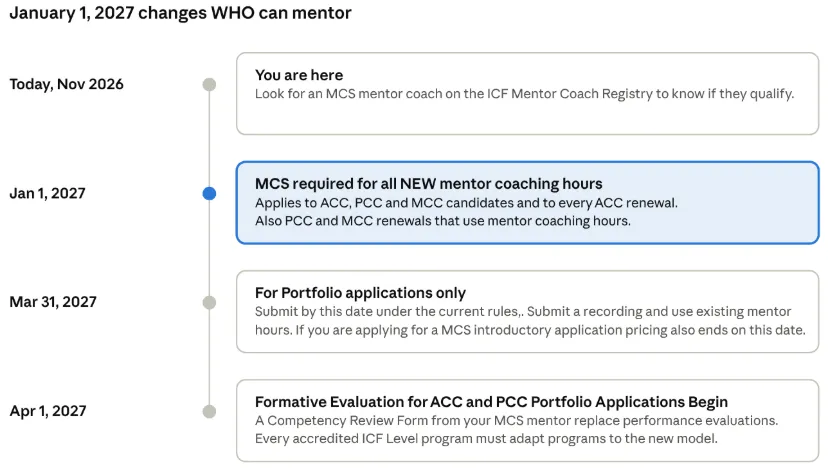
The dates that matter
January 1, 2027 is the date to watch. April 1st, 2027 matters most if you’re applying through the Portfolio path.
Most important
This is the part that worries coaches in training and causes confusion.
If you are already enrolled in an all-inclusive ICF Level program– Level 1 (ACC), Level 2 (PCC) and Level 3 (MCC)– you have until Dec 1, 2027 to submit a Performance Evaluation to meet the requirements of your program and earn your Level certificate.
Once you have that certificate in your hands, as long as the date on it is prior to Dec 1, 2027, you can use that for your ICF Credential application anytime, whether or not you were mentored by an MCS. That certificate certifies that you have accomplished the requirements of the accredited program and therefore qualify. That certificate does not expire.
Find your path
Portfolio applicants will experience the biggest change. Everyone else mostly needs to check one thing: that their mentor coach holds the MCS.
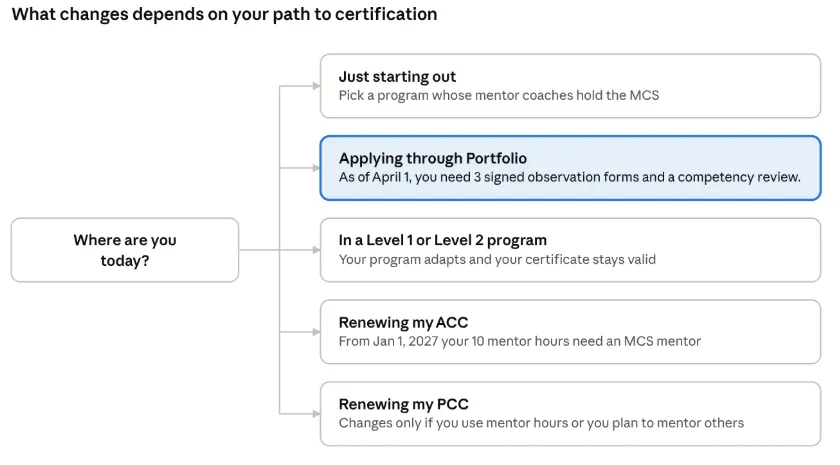
Let’s break it down
I’m applying through the Portfolio path
What applies to you depends on ONE thing: the date you submit your ACC or PCC application.
| Submit BEFORE April 1, 2027 | Submit ON or AFTER April 1, 2027 | |
|---|---|---|
| Recorded performance evaluation | Required (1 recording for ACC, 2 for PCC) | Gone. Replaced by your mentor coach’s review |
| Mentor coaching | 10 hours, over 3+ months, at least 3 hours one-to-one | Same 10 hours, over 3+ months, at least 3 hours one-to-one |
| Who can be your mentor coach | Hours done before Jan 1, 2027: current rules. Hours done from Jan 1, 2027: an MCS holder | An MCS holder at the right level |
| Sessions observed by your mentor | No set minimum | At least 3 of your coaching sessions observed and reviewed |
| What goes in your application | Mentor coaching verification + recording(s) and transcript(s) | A Competency Review Form completed by your mentor coach — signed |
| What you keep on file | Nothing extra | Three Session Observation Forms, one for each reviewed session, in case of audit — signed |
What to do now
- Ask any mentor coach you’re considering whether they hold the MCS at your credential level, or will before January 1, 2027. The ICF Mentor Coach Registry is where you check.
- If you’re close to ready, decide which side of April 1, 2027 suits you. Before that date you submit a recording. After it, you’re evaluated across several sessions in your own language and context — which will add costs.
- Applying for MCC through Portfolio? The recorded performance evaluation stays for MCC. Only your mentor coach requirement changes.
I’m in a Level 1 or Level 2 program
You can breathe. ICF has confirmed that Level path applicants for ACC (Level 1 or 2) and PCC (Level 2) don’t need to do anything differently. Your mentor coaching and skills evaluation are built into your program.
- Your certificate stays valid. If you finish your program before April 1, 2027 and apply after that date, ICF still accepts your Level 1 or Level 2 certificate.
- Your program does the adapting. Every accredited program must move to the new mentor coaching model by April 1, 2027, which includes working with mentor coaches who hold the MCS.
- The rest of your journey is unchanged. You still log your coaching hours (100+ for ACC, 500+ for PCC) and pass the ICF exam for your level.
For our own students: Coach Academy’s Level 1 and Level 2 programs already include mentor coaching, and all of our facilitators and mentors are qualified MCS. We are aligning with the new requirement ahead of the April 2027 deadline. If you’re mid-program, your path to your credential stays the same.
I’m renewing my ACC
An important change you need to be aware of: WHO you do your mentor coaching with matters. From January 1, 2027, the 10 mentor coaching hours required for every ACC renewal must be done with a mentor coach who holds the MCS. Hours you complete before that date still count.
Your renewal, every three years:
| Requirement | What you need |
|---|---|
| Total Continuing Coach Education (CCE) | 40 credits |
| Coaching Ethics | 3 credits (ICF offers a free course) |
| Mentor coaching | 10 hours, over at least 3 months, counted as Core Competency credits |
| Other Core Competencies | 11 credits |
| Core Competencies or Resource Development | 16 credits |
| Fee (always check ICF site for current fees) | $175 USD (ICF member), $275 USD (non-member) |
Deadlines worth knowing
- You can submit your renewal up to 10 months before your credential expires.
- Miss the date and you have a 2-month grace period with no penalty.
- After that, you have 10 more months to renew, with a $100 USD late fee.
- Past 12 months, your credential is fully expired and you start over with a new application.
A practical tip: if your ACC expires in 2027, any mentor coaching you finish with your current mentor coach before January 1, 2027 still counts. And once you’ve renewed your ACC, you become eligible to earn the MCS yourself.
I’m renewing my PCC
Your renewal stays almost exactly as it is. Mentor coaching is optional for PCC renewal, so the new rule only touches you if you choose to use mentor coaching hours as part of your CCE. In that case, hours done from January 1, 2027 must be with an MCS holder.
| Requirement | What you need |
|---|---|
| Total Continuing Coach Education (CCE) | 40 credits, every three years |
| Core Competencies | 24 credits, including 3 in Coaching Ethics |
| Core Competencies or Resource Development | 16 credits |
| Mentor coaching | Optional. If used from Jan 1, 2027, with an MCS holder |
| Fee (always check ICF site for current fees) | $175 USD (ICF member), $275 USD (non-member) |
The same renewal windows apply: submit up to 10 months early, a 2-month grace period, then 10 months with a late fee.
Two situations where it matters more
- You mentor other coaches. From January 1, 2027, you need the MCS to keep providing mentor coaching to ICF credential candidates. See the MCS section below.
- You’re working toward your MCC. Your 10 mentor coaching hours need an MCS holder at the MCC level, and the MCC performance evaluation recording stays in place.
I’m just starting my coach certification journey
You are arriving at a good moment. If you begin in 2027, you will never know the old system. Your growth will be observed across several sessions, by someone trained to give you useful feedback.
Here is what every ICF credential asks of you:
| ACC | PCC | MCC | |
|---|---|---|---|
| Coach education | 60+ hours | 125+ hours | 200+ hours |
| Coaching experience | 100+ hours | 500+ hours | 2,500+ hours |
| Mentor coaching | 10 hours | 10 hours | 10 hours |
| Exam | ACC Exam | ICF Credentialing Exam | ICF Credentialing Exam |
| Prerequisite | None | None | A PCC |
Four questions to ask any program before you enroll
- Is it ICF accredited at Level 1, Level 2 or Level 3? Check the program in ICF’s own education directory, not only on the provider’s website.
- Is mentor coaching included, or will you need to find and pay for it separately?
- Do the program’s mentor coaches hold the MCS, or will they before 2027?
- How will your coaching be observed and given feedback along the way? Level 1 programs, for example, must observe at least five of your coaching sessions and give written feedback on at least three.
A Level program bundles your education, mentor coaching and skills evaluation into one path. The Portfolio path gives you more flexibility to combine courses, with more paperwork, longer review times and added costs.
What is the MCS?
The Mentor Coach Specialization (MCS) is ICF’s new designation for the coaches who mentor other coaches. Until now, any coach with a PCC, an MCC or a renewed ACC could mentor a credential candidate, with no training required in how to observe, evaluate or give feedback. The MCS sets that standard. From January 1, 2027, it is required to mentor anyone toward an ICF credential or an ACC renewal.
It comes in three levels, matching the credential you mentor toward: MCS at ACC, PCC and MCC level. One application fee covers whichever levels you qualify for.
| Standard Path | Credit for Prior Learning Path | |
|---|---|---|
| Who it suits | Coaches new to mentor coaching, or anyone wanting structured training | Experienced mentor coaches with a track record |
| Credential | Near completion of or active PCC, MCC or renewed ACC | Active PCC, MCC or renewed ACC |
| Mentor coaching education | 41+ hours aligned to the ICF Mentor Coaching Competencies, at least 50% live | 10+ hours aligned to the ICF Mentor Coaching Competencies |
| ICF evaluation training | ACC BARS, PCC Markers and/or MCC BARS, for each level you want | Same |
| Evidence of experience | Not required | 5 mentoring clients who earned a credential in the past 3 years, or a letter from an ICF-accredited provider confirming 5 mentored students |
| Application fee | $50 USD members, $125 USD non-members until March 2027. Then $125 and $200 (fees may change) | Same |
Keeping it: the MCS renews every three years. You keep an active ICF credential and complete 10 hours of continuing education aligned with the Mentor Coaching Competencies. The renewal fee is $100 USD for members and $200 USD for non-members, and one renewal covers every level you hold.
Being found: MCS holders are listed on ICF’s Mentor Coach Registry. After January 1, 2027, only MCS holders appear there.
What is the AAMC?
The Advanced Accreditation in Mentor Coaching (AAMC) is an accreditation for PROGRAMS that train mentor coaches. A person earns the MCS; a training program earns the AAMC. ICF opened applications for it in June 2026, separate from its Level 1, 2 and 3 accreditations.
Why it matters to you: completing an AAMC-accredited program meets the education requirement for the MCS. It is the most direct route, because ICF has already reviewed the program against its standards. AAMC programs include mentor-coaching-specific education, observed mentor coaching sessions, reflective development, and training in ICF’s evaluation standards and competency markers.
If you’re choosing a mentor coach training, ask whether the program holds the AAMC. If it doesn’t, check that its hours and content meet the Standard Path requirements on their own.
What counts as ICF coach education?
Will my training count? That depends on which kind of education you took and which path you apply through.
| Type of education | Hours | Leads to | What it covers |
|---|---|---|---|
| Level 1 accredited | 60 to 124 | ACC (Level path) | Education, mentor coaching and skills evaluation, all included |
| Level 2 accredited | 125+ | PCC or ACC (Level path) | Education, mentor coaching and skills evaluation, all included |
| Level 3 accredited | 200+ | MCC (Level path, PCC required) | Education and mentor coaching included |
| Continuing Coach Education (CCE) | Varies | Counts toward Portfolio hours and credential renewal | Education only |
| Non-accredited coach training | Varies | Portfolio path only, with full program documentation | Education only, if it teaches the ICF Core Competencies and Code of Ethics |
| AAMC accredited | Program-specific | The MCS (education requirement) | Training to become a mentor coach |
Where Coach Academy’s programs sit:
- Certified Life Coach and Certified Leadership Coach: Level 1
- Certified Professional Coach and Certificate in Advanced Coaching Skills: Level 2
- Certified Master Coach: Level 3
One rule of thumb holds across every path: finish ALL your education hours before you submit your application.
Before you choose a mentor coach, try this
A credential is a list of requirements. Mentor coaching is a relationship, and these changes give that relationship more weight than it has ever carried. Your mentor coach becomes the person who watches your coaching closely enough to vouch for it.
So treat your first conversation with a prospective mentor coach as a small experiment. Ask whether they hold the MCS, and at what level, because that answer now decides whether your hours count. Then ask a second question: “What will you be listening for when you observe my coaching?” Notice what comes back. Notice whether you feel evaluated or witnessed… and whether they ask you more questions than they answer.
If you’re still unsure which path is yours, bring your question to us. Coaches in our community are working through the same changes, and the thinking is better together.
Sources
- ICF: ACC and PCC Performance Evaluation to Be Replaced by Enhanced Mentor Coaching Requirement (updated April 24, 2026)
- ICF: Introducing the Mentor Coach Specialization (updated June 17, 2026)
- ICF: Renew Your Credential or Specialization
- ICF: Compare ICF Coaching Credentials and Specializations
- ICF: Advanced Accreditation in Mentor Coaching
- ICF: Now Available, Advanced Accreditation in Mentor Coaching
- ICF: Level 1 Accreditation
- ICF Mentor Coach Registry